Mixcraft Review 2026: A Powerful, Beginner-Friendly DAW That Punches Above Its Price
If you're searching for a digital audio workstation that balances power, simplicity, and affordability, Mixcraft by Acoustica, LLC deserves serious attention. Known for its intuitive interface and rich built-in content, Mixcraft continues to evolve into a capable DAW for both beginners and semi-professional producers. In this in-depth review, we explore its features, performance, workflow, and real-world usability to determine whether it truly competes with industry giants—or remains a hidden gem.

Introduction
In a market dominated by heavyweights like Ableton Live and Logic Pro, it's easy to overlook smaller players. But that would be a mistake—especially when it comes to Mixcraft.
Developed by Acoustica, Mixcraft has quietly built a reputation as one of the most accessible DAWs on Windows. What started as a simple recording tool has evolved into a full-fledged production environment capable of handling everything from podcasting to complex music production.
This software is clearly aimed at beginners and intermediate producers, but recent updates have added enough depth to attract more experienced users as well. The question is: does it deliver enough power to justify choosing it over more established competitors?
Pricing & Plans
Mixcraft keeps things refreshingly simple with two main versions:
- Mixcraft Recording Studio – Budget-friendly entry point
- Mixcraft Pro Studio – Full-featured version
Value Analysis:
The Recording Studio version is ideal for beginners who want essential tools without overwhelming complexity. Meanwhile, Pro Studio includes advanced plugins, additional instruments, and more mixing tools—making it the better long-term investment.
Compared to competitors, Mixcraft offers exceptional value. You get a lifetime license (no subscription), which is increasingly rare in today’s DAW ecosystem.
System Requirements
Platform: Windows only (no native macOS support)
Minimum Requirements:
- Windows 10/11
- 4 GB RAM
- Dual-core CPU
Recommended:
- 8–16 GB RAM
- SSD storage
- Multi-core CPU
Performance scales well with better hardware, but even mid-range systems handle Mixcraft comfortably.
Interface & User Experience
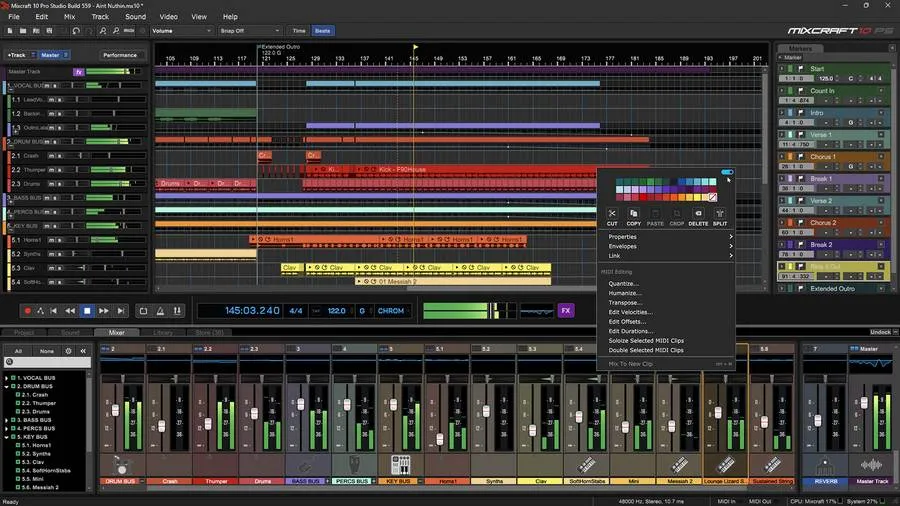
One of Mixcraft’s biggest strengths is its interface.
From the moment you launch it, everything feels approachable. The layout follows a traditional DAW structure—timeline at the center, tracks stacked vertically, and tools neatly arranged.
Highlights:
- Drag-and-drop functionality
- Clean, uncluttered design
- Beginner-friendly workflow
The learning curve is minimal. Unlike more complex DAWs, Mixcraft doesn’t overwhelm you with menus or hidden features. Everything is visible and intuitive.
Weakness: The UI, while functional, lacks the modern polish seen in premium DAWs.

Core Features Breakdown
Mixcraft has matured significantly over the years, and its feature set reflects that.
1. Multitrack Recording
Supports unlimited audio and MIDI tracks, making it suitable for full productions.
2. MIDI Editing
The piano roll is simple but effective, with enough tools for most workflows.
3. Automation
Automation lanes are easy to use and visually clear.
4. Video Editing
A standout feature—Mixcraft includes built-in video editing, useful for YouTubers and content creators.
5. New & Updated Features (Latest Versions)
- Improved automation curves
- Enhanced time-stretching algorithms
- Better VST compatibility
- Expanded sound library
These updates push Mixcraft closer to professional territory, though it still prioritizes ease of use over complexity.
Performance & Stability
In real-world use, Mixcraft performs reliably.
Performance Notes:
- Fast startup time
- Low CPU usage for basic projects
- Stable with moderate plugin loads
However, large projects with heavy VST usage can push the limits. It’s not the most optimized DAW on the market, but it’s solid for its target audience.
Tools, Plugins, or Built-in Content
This is where Mixcraft shines.
The Pro Studio version includes a surprisingly rich collection of instruments and effects.
Included Content:
- Virtual instruments (pianos, synths, drums)
- Effects (EQ, compression, reverb)
- Loops and samples library
The quality is respectable—not industry-leading, but more than enough to produce professional-sounding tracks.
Workflow & Productivity
Mixcraft is designed for speed and simplicity.
Workflow Advantages:
- Minimal setup required
- Quick recording and editing
- Efficient drag-and-drop system
Compared to more complex DAWs, Mixcraft allows users to focus on creativity rather than technical setup.
That said, advanced users may find it lacking in deep customization.
Pros & Cons
Pros:
- Extremely beginner-friendly
- Affordable with no subscription
- Solid built-in instruments
- Video editing included
- Fast workflow
Cons:
- Windows only
- UI feels slightly dated
- Limited advanced features
- Not ideal for massive projects
Comparison
Vs Ableton Live:
Ableton offers deeper performance tools and live capabilities, but Mixcraft is easier for beginners.
Vs Logic Pro:
Logic has superior sound libraries and polish, but Mixcraft is more accessible and affordable.
Vs FL Studio:
FL Studio excels in beat-making, while Mixcraft is better for linear recording workflows.
In short, Mixcraft competes on usability—not raw power.
Final Verdict
Mixcraft is one of the most underrated DAWs available today.
It may not dethrone industry giants, but it doesn’t try to. Instead, it focuses on what matters most for many users: simplicity, speed, and value.
Who should use it:
- Beginners entering music production
- Content creators and YouTubers
- Budget-conscious producers
Who should skip it:
- Advanced producers needing deep control
- Mac users
- Very beginner-friendly interface
- Affordable compared to pro DAWs
- Includes many built-in instruments & effects
- Great for home studio and indie creators
- Windows only (no native Mac support)
- Less advanced than premium DAWs
- UI feels simpler compared to competitors
Cubase Pro 15 Review: The Most Complete DAW for Modern Producers?
Cubase Pro 15 by Steinberg refines one of the most powerful digital audio workstations available today. With smarter workflow tools, deeper MIDI capabilities, and improved
-
By: Adrian Vexley
GarageBand Review 2026: Is Apple’s Free DAW Still Worth It?
GarageBand by Apple Inc. remains one of the most accessible digital audio workstations available today. Built for macOS and iOS, it offers an intuitive interface, high-quality
-
By: Adrian Vexley
Best DAW Software 2026: Top 7 Picks for Beginners & Music Producers
Choosing the right DAW in 2026 can completely change how you make music. The wrong software slows you down—while the right one can turn ideas into finished tracks in minutes. In
-
By: Ardi Pratama

KORG Gadget 3 Review (2026): Fastest Way to Make Music or Just a Sketch Tool?
There’s a quiet difference between software that offers possibilities… and software that actually moves you forward. KORG Gadget 3 sits firmly in the latter. Not because it does
-
By: Richard Holloway

Fender Studio Pro Review (2026): A Surprising All-In-One DAW with Studio-Grade Power
Fender Studio Pro, developed by PreSonus Audio Electronics, Inc., enters the competitive DAW market with a bold promise: combine studio-grade production tools with musician-first
-
By: Adrian Vexley
Bitwig Studio Review 2026: The Most Innovative DAW for Modern Producers?
If you're looking for a DAW that truly pushes creative boundaries, Bitwig Studio by Bitwig GmbH stands out as one of the most forward-thinking options available today. Built
-
By: Adrian Vexley