Understanding the Philosophy Behind Melodyne
Melodyne approaches audio editing from a musical perspective rather than a purely technical one. Instead of treating sound as a waveform to be sliced and processed, it interprets audio as individual notes—each with pitch, timing, amplitude, and even tonal characteristics.
This distinction matters.
By converting audio into editable “blobs,” Melodyne allows you to interact with recordings in a way that feels closer to MIDI editing, yet retains the nuance of the original performance. The result is a workflow that encourages precision without sacrificing musicality.
Where Melodyne Fits in a Creative Workflow
In most production environments, editing is not a separate phase—it is a continuation of intent. Once a performance has been recorded, the focus naturally shifts from capturing ideas to shaping them into something cohesive. This is where Celemony Melodyne becomes relevant: not as a tool to “fix mistakes,” but as a means to align performance with the artistic direction of the track.
Rather than approaching it as a single-purpose processor, it is more useful to see Melodyne as operating across three interconnected stages—each with a different level of intervention and responsibility within the workflow.
1. Correction (Technical Alignment)
At the foundational level, Melodyne addresses the small inconsistencies that inevitably occur in recorded audio. Even strong performances—particularly vocals—can contain slight pitch deviations or timing irregularities that, while subtle in isolation, can accumulate and affect the overall clarity of a mix.
Correction, in this context, is not about enforcing perfection. It is about establishing stability.
Pitch adjustments ensure that notes sit comfortably within the harmonic framework of the arrangement, reducing friction between elements. Timing refinements help align phrases with the groove, especially in productions where rhythmic precision supports the intended feel.
What distinguishes Melodyne here is the degree of control it offers. Instead of applying global correction, each note can be adjusted independently. This allows you to retain expressive nuances—such as intentional slides or vibrato—while addressing only the parts that disrupt the balance.
In practice, this stage often involves restraint. The goal is to reach a point where the listener no longer notices the imperfections, without ever noticing the correction itself.
2. Enhancement (Musical Intent)
Once the technical foundation is in place, the role of Melodyne becomes more interpretative. At this stage, the question shifts from “Is this correct?” to “Does this communicate clearly?”
Enhancement involves shaping the performance so that its musical intent is more evident. This might include refining note transitions to create smoother phrasing, adjusting note lengths to improve articulation, or subtly rebalancing dynamics so that important moments are given appropriate emphasis.
For vocals, this can mean guiding the emotional contour of a phrase—ensuring that sustained notes feel supported, and that transitions between notes feel intentional rather than incidental. For instruments, it may involve tightening interactions between layered parts, allowing them to occupy their space without competing.
Melodyne’s strength in this stage lies in how it separates different dimensions of sound. Pitch, timing, amplitude, and tonal characteristics can be adjusted independently, which makes it possible to refine one aspect without unintentionally affecting another.
The outcome is not a “corrected” performance, but a clarified one—where the original intent becomes easier to perceive within the context of the mix.
3. Creative Manipulation (Recomposition)
At a more advanced level, Melodyne extends beyond editing into the realm of composition. This is where its note-based approach begins to shift the role of audio itself—from a fixed recording into something more flexible and reworkable.
In this stage, you are no longer limited to preserving what was performed. Instead, you can reinterpret it.
Melodies can be reshaped to better support the harmonic progression. Harmonies can be derived from a single vocal line. With polyphonic material, individual notes within chords can be isolated and adjusted, allowing for harmonic corrections or entirely new voicings without re-recording.
This capability becomes particularly valuable in situations where revisiting the recording session is not practical. Rather than treating limitations as constraints, Melodyne provides a controlled environment for rethinking musical ideas directly within the audio domain.
However, this level of manipulation requires a clear sense of direction. Without it, the flexibility can lead to decisions that feel disconnected from the original performance. Used intentionally, though, it allows for a seamless transition between editing and composing—where refinement and creation become part of the same process.
A Continuum, Not Separate Steps
While these stages are described individually, they rarely exist in isolation. In practice, they form a continuum.
A small correction may reveal an opportunity for enhancement. An enhancement may suggest a compositional adjustment. The workflow moves fluidly between these layers, guided by the needs of the track rather than a fixed sequence of steps.
Melodyne supports this fluidity by maintaining a consistent interface and philosophy throughout. Whether making minor adjustments or significant transformations, the underlying approach remains the same: interact with sound as music, not just as data.
This consistency is what allows it to integrate naturally into a creative workflow—supporting decisions without interrupting them, and enabling refinement without breaking the flow of production.
Key Features That Support This Workflow
Rather than treating features as isolated capabilities, it’s more useful to understand how each one contributes to a larger creative process. In Melodyne, the design of these tools reflects a consistent idea: editing should feel like shaping a performance, not correcting a mistake.
Note-Based Editing
At the core of Celemony Melodyne is its note-based editing system, which fundamentally changes how audio is approached. Instead of working with continuous waveforms, Melodyne separates audio into individual notes—each represented as a distinct, editable element.
This allows for a level of control that feels both precise and musical. Pitch can be adjusted per note, but more importantly, it can be adjusted gradually. You’re not limited to snapping notes into place; you can guide them toward a desired pitch while preserving natural drift and expression.
Timing adjustments follow a similar philosophy. Rather than forcing notes onto a rigid grid, you can shift them in relation to surrounding material, maintaining the original phring while improving alignment. Length and amplitude controls further extend this, making it possible to subtly rebalance a performance without re-recording it.
What emerges is a workflow where correction becomes refinement. The performance remains intact—but more intentional.
DNA (Direct Note Access)
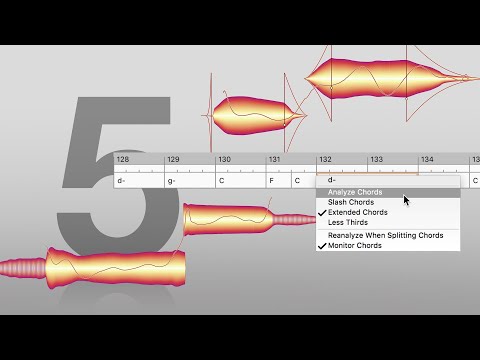
DNA is arguably one of Melodyne’s most defining contributions to modern audio editing. Traditionally, once audio is recorded polyphonically—such as a guitar chord or piano passage—it becomes a single, inseparable entity. Melodyne challenges this limitation.
With DNA, polyphonic material is analyzed and separated into individual notes within a chord. This means a single wrong note inside a complex harmony can be corrected without affecting the rest. More importantly, it allows harmonic restructuring after the fact.
In practice, this opens a range of creative decisions:
- Adjusting chord voicings to better support a vocal
- Correcting harmonic clashes without re-recording
- Extracting inner melodies that were previously embedded
It shifts polyphonic audio closer to the flexibility of MIDI, but without losing the organic detail of recorded sound. However, its effectiveness still depends on the source material—clean recordings yield more reliable separation, reinforcing the idea that Melodyne works best as part of a thoughtful recording process, not a replacement for it.
Timing and Groove Control
Timing, in most editing environments, is often treated as a problem to be solved through quantization. Melodyne approaches it differently—treating timing as a musical characteristic rather than a technical flaw.
Its timing tools allow you to move notes freely, but always in context. Instead of snapping everything to a strict grid, you can align elements relative to each other, or to a groove reference, preserving the subtle push-and-pull that defines human performance.
This becomes especially valuable in vocal production. Small timing inconsistencies can affect clarity, yet over-quantization can strip away emotion. Melodyne provides a middle ground: alignment that feels intentional, but not mechanical.
Additionally, its time-handling respects transients and phrasing. Stretching or compressing notes does not feel destructive—it remains coherent, even under detailed adjustments.
The result is a workflow where timing is shaped, not corrected. You’re not forcing a performance into place; you’re guiding it toward cohesion.
Formant and Tone Shaping
Pitch correction often introduces an unintended side effect: it alters the tonal identity of a sound. This is particularly noticeable in vocals, where even slight changes can affect perceived character.
Melodyne addresses this through independent formant control. In simple terms, while pitch determines what note is heard, formants influence how that note sounds. By separating these two elements, Melodyne allows you to adjust pitch without distorting the natural tone.
This becomes essential in several scenarios:
- Correcting large pitch deviations while maintaining vocal identity
- Shifting notes creatively without producing artificial artifacts
- Matching tonal consistency across multiple takes
Beyond formants, Melodyne also offers subtle tools for shaping amplitude and note transitions. These are not immediately obvious features, but they contribute significantly to realism. Adjusting how a note begins, sustains, or resolves can often be more impactful than pitch correction itself.
Taken together, these controls reinforce a key principle: editing is not just about accuracy—it’s about preserving intention.
Bringing It All Together
What makes these features meaningful is not their individual capabilities, but how they interact within a single workflow. Melodyne does not push you toward a specific outcome. Instead, it provides a set of tools that respond to how you choose to shape a performance.
Used carefully, these features allow you to move beyond correction and into interpretation—where editing becomes part of the creative process, rather than a step that follows it.
Strengths in Practice
What makes Celemony Melodyne particularly effective is not simply the presence of advanced features, but the way those features align with a coherent, musically grounded workflow. It is a tool that encourages deliberate decisions—where each adjustment serves a purpose within the broader context of the arrangement.
Musical Perspective
At the core of Melodyne is its ability to reinterpret audio as musical information. This shifts the editing process from a visual, waveform-based task into something more intuitive and composition-oriented. Instead of reacting to peaks and transients, you are working with notes, intervals, and phrasing.
This becomes especially valuable when refining vocals or melodic instruments. Small pitch deviations can be corrected while still preserving the natural movement between notes. More importantly, it allows you to evaluate a performance in terms of intent—whether a note feels late, whether a phrase resolves properly—rather than simply whether it is “correct.”
Over time, this perspective changes how decisions are made. Editing becomes less about fixing mistakes, and more about reinforcing the musical narrative of a track.
Precision Without Aggression
One of Melodyne’s more understated strengths is how it handles subtlety. Many pitch correction tools tend to impose a certain character when pushed—even slightly—leading to results that feel overly processed or detached from the original performance.
Melodyne, by contrast, allows for incremental adjustments that remain largely transparent. Pitch drift can be tightened without forcing notes rigidly into place, and timing can be aligned without eliminating the natural push and pull that gives a performance its feel.
This level of control is particularly important in genres where expression matters as much as accuracy. A vocal line, for example, can retain its emotional nuance even after being technically refined. The tool does not override the performance; it supports it.
In practice, this encourages a slower, more attentive workflow—one where adjustments are made progressively, with space to listen and reassess.
Scalability Across Workflow Depth
Melodyne adapts well to different levels of involvement, which makes it relevant across a wide range of production scenarios.
At a surface level, it can function almost invisibly—tightening pitch or timing in a way that integrates seamlessly into an existing session. In these cases, the goal is efficiency: addressing small inconsistencies without interrupting the creative flow.
At a deeper level, however, Melodyne becomes a detailed editing environment. Here, you can reshape phrasing, rework harmonies, or reinterpret recorded material entirely. Its note-based system, combined with features like formant control and polyphonic editing, allows for a level of intervention that extends beyond correction into creative restructuring.
What’s notable is that these layers do not feel disconnected. The same interface supports both quick adjustments and detailed refinement, allowing you to scale your approach based on the needs of the project.
Taken together, these strengths point to a larger idea: Melodyne is not defined by isolated features, but by how naturally it integrates into a thoughtful production process. It supports precision without enforcing rigidity, and offers depth without demanding unnecessary complexity.
Limitations to Consider
Melodyne’s depth is one of its defining strengths, but it also introduces a set of expectations. This is not a tool designed for purely reactive editing—it assumes that the user approaches audio with a clear sense of direction, both technically and musically. Without that foundation, its capabilities can feel excessive rather than empowering.
Learning Curve: Interpreting Audio as Musical Data
While the interface itself is visually approachable, the underlying concept requires a shift in perspective. Melodyne does not operate like a traditional waveform editor—it presents audio as discrete musical elements. To use it effectively, you need to think in terms of pitch relationships, phrasing, timing grids, and harmonic context.
This can be challenging for users without a grounding in musical structure. Adjustments may be technically accurate, yet musically unconvincing. Even for experienced producers, there is an initial period of adapting to how Melodyne interprets audio—particularly when working with complex or polyphonic material.
In practice, the learning curve is less about understanding the tool, and more about developing the judgment to use it with restraint.
Time Investment: Precision Requires Deliberation
Melodyne encourages a level of detail that naturally slows down the editing process. Each note can be shaped individually, which is powerful—but also time-intensive.
Refining a vocal, for instance, is rarely just about pitch correction. It involves evaluating phrasing, adjusting timing, balancing natural variation, and preserving articulation. These layers of decision-making accumulate, especially in dense sessions with harmonies or multiple takes.
This is not inherently a drawback—but it does require intention. Melodyne rewards patience, and its results tend to reflect the time invested in the process.
Not Always Necessary: Matching the Tool to the Context
There are scenarios where Melodyne’s depth exceeds the needs of the project. In faster workflows—such as demos, content production, or deadline-driven work—efficiency often takes priority over nuance.
In these cases, simpler tools may provide results that are sufficient with significantly less effort. Melodyne, by contrast, invites deeper involvement. If that level of involvement is not aligned with the project’s goals, it can introduce unnecessary complexity.
Additionally, not every performance benefits from detailed refinement. Some recordings rely on subtle imperfections to retain their character. Over-editing, even with a transparent tool, can reduce that sense of authenticity.
System Performance and Workflow Integration
Depending on how Melodyne is used—whether as a standalone application or plugin—it can also introduce technical considerations.
Sessions with multiple instances may increase CPU usage, and workflows without ARA integration can require additional steps for audio transfer. While ARA significantly streamlines this process, it still depends on DAW compatibility and setup.
As such, using Melodyne effectively involves not only creative decisions, but also an understanding of how it integrates into your technical environment.
A Tool That Reflects Your Decisions
Ultimately, Melodyne does not impose limitations in a restrictive sense—it reflects the level of clarity you bring into the process.
If the goal is undefined, the tool can feel overwhelming.
If the intent is clear, it becomes precise and dependable.
This duality is central to its design. Melodyne offers depth, but it expects direction. And in many ways, that expectation is what defines its role—not as a quick solution, but as a deliberate extension of musical judgment.
A Tool That Rewards Intentional Use
Melodyne reveals its full value only when approached with clear intent. It is not designed to “fix” performances in a reactive sense, nor does it encourage a workflow built around constant correction. Instead, it provides a structured environment where each adjustment is a conscious decision—one that serves the musical outcome rather than simply addressing technical imperfections.
This distinction becomes increasingly important as projects grow in complexity. In a dense mix, small inconsistencies in pitch or timing can accumulate and subtly affect the overall clarity. Melodyne allows these details to be addressed with precision, but more importantly, it allows them to be addressed selectively. Not every note needs correction, and not every imperfection is a problem. The tool supports this level of discernment by making each element of a performance visible, editable, and—crucially—contextual.
From a workflow perspective, this shifts the role of editing from a corrective phase into a refinement stage. Instead of interrupting the creative process, Melodyne can be integrated as a continuation of it. After recording, when the initial energy of a performance is already captured, Melodyne offers a way to shape that material without losing its character. Adjustments can be as minimal as stabilizing a single note, or as involved as rebalancing an entire vocal phrase to better support the arrangement.
There is also a broader creative implication here. Because Melodyne treats audio as flexible musical data, it encourages exploration beyond correction. A vocal line can be subtly rephrased to improve phrasing; a guitar chord can be revoiced to sit more naturally within the harmonic structure; timing can be nudged to enhance groove rather than conform strictly to a grid. These are not fixes—they are decisions that influence how the listener perceives the performance.
In this way, Melodyne aligns closely with a production mindset that prioritizes refinement over correction, and clarity over convenience. It does not impose a predefined aesthetic or push the user toward a specific sound. Instead, it creates space for thoughtful editing—where each change is evaluated in relation to the whole mix, not in isolation.
Rather than asking what can this tool fix, a more useful question becomes:
What can this performance become with careful adjustment?
That shift in perspective changes how the tool is used. Editing becomes less about eliminating flaws and more about revealing potential—bringing out qualities that were already present but not yet fully realized.
Ultimately, Melodyne rewards patience and attention to detail. It favors users who are willing to listen closely, make deliberate choices, and treat editing as part of the musical process itself. In return, it offers a level of control that feels less like manipulation and more like refinement—quiet, precise, and always in service of the music.